What Is the Country Sumers Most Famous Work of Art
Considered the cradle of Civilization, aboriginal Mesopotamia was habitation to Sumer, located in the southern parts and ane of its primeval and advanced civilizations during the Neolithic and early Bronze age. This article will explore the Sumerian civilisation and their artwork, ranging from pottery, statues, and architecture.
Table of Contents
- 1 Brief Historical Overview: "The Land Between the Rivers"
- 1.1 Earliest Ancient Civilizations: Sumer
- 2 Sumerian Art
- 2.one Ram in a Thicket (c. two 600 BC to two 400 BC)
- 2.two Standard of Ur (c. 2 600 BC to 2 400 BC)
- 2.iii The Queen'south Lyre (c. 2 600 BC)
- 2.4 Warka (Uruk) Vase (c. 3 200 BC – 3 000 BC)
- three Sumerian Architecture
- 4 From Writing to Wheels: The Sumerians Remembered
- five Frequently Asked Questions
- five.ane When Was the Sumerian Period?
- 5.2 What Does "Sumer" Hateful?
- 5.three What Kind of Art Was Created in Sumer?
- 5.4 What Was the Purpose of Sumerian Art?
Brief Historical Overview: "The Land Betwixt the Rivers"
The Fertile Crescent tin be institute in the Well-nigh Middle East. It is also considered a Cradle of Civilisation because of the rate of evolution of farming settlements, domestication, and other technological and cultural advancements like the bicycle and writing. The name was introduced as the "Fertile Crescent" by the archaeologist James Henry Breasted in the publications Outlines of History (1914) and Ancient Times, A History of the Early Globe (1916). He described this region of the Middle East as follows:
"This fertile crescent is approximately a semi-circle, with the open side toward the southward, having the due west end at the southeast corner of the Mediterranean, the center directly north of Arabia, and the eastward stop at the due north end of the Western farsi Gulf".
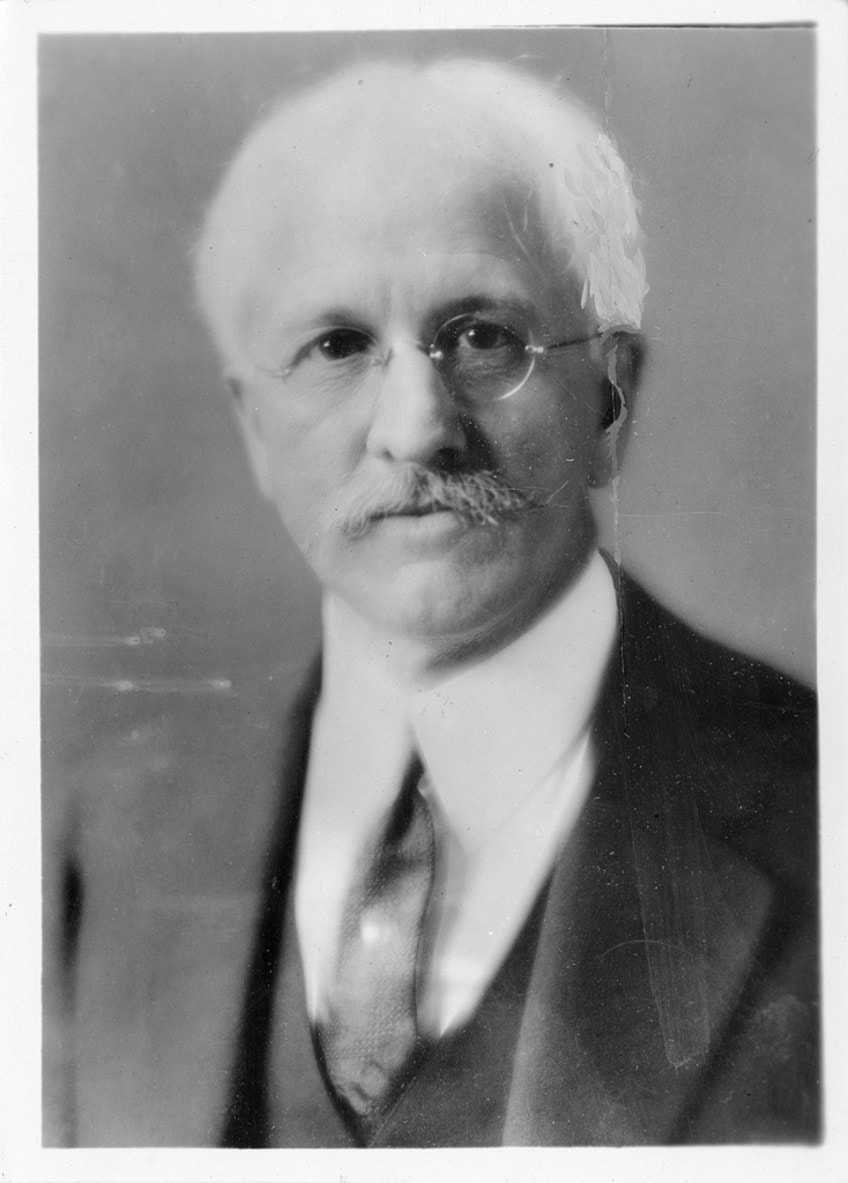 Egyptologist James Henry Breasted (1865-1935); Smithsonian Institution Archives, Public domain, via Wikimedia Commons
Other sources draw information technology every bit a "boomerang" shape, with the various regions surrounding it. These regions include areas of present-day Cyprus, Egypt, Iran, Iraq, State of israel, Jordan, Lebanon, Palestine, Syria, and Turkey.
As the proper noun suggests, it was a fertile region with arable land and fresh water sources. Its vast biodiversity made it fit for farming and agronomics thousands of years ago when hunter-gatherers gradually transitioned to a more than settled manner of life. Information technology is also located between North Africa and Eurasia and has been described every bit a "span" betwixt these two regions.
Information technology is no wonder then that the Fertile Crescent has been regarded as a Cradle of Civilization – it has been the birthplace of development and advancements of non only human civilization but likewise biodiversity.
If we zoom in to some of the first human being civilizations that started here, we volition find ancient Mesopotamia, which is now in the region of nowadays-twenty-four hours Iraq, and other regions like Iran, Syrian arab republic, Turkey, and Kuwait. Mesopotamia lies between the Tigris and Euphrates rivers and the name means the "land between the rivers". Information technology is i of four other river valley civilizations, the others existence the Indus Valley Civilization, the Nile Valley in ancient Arab republic of egypt, the Yellowish River in ancient China.
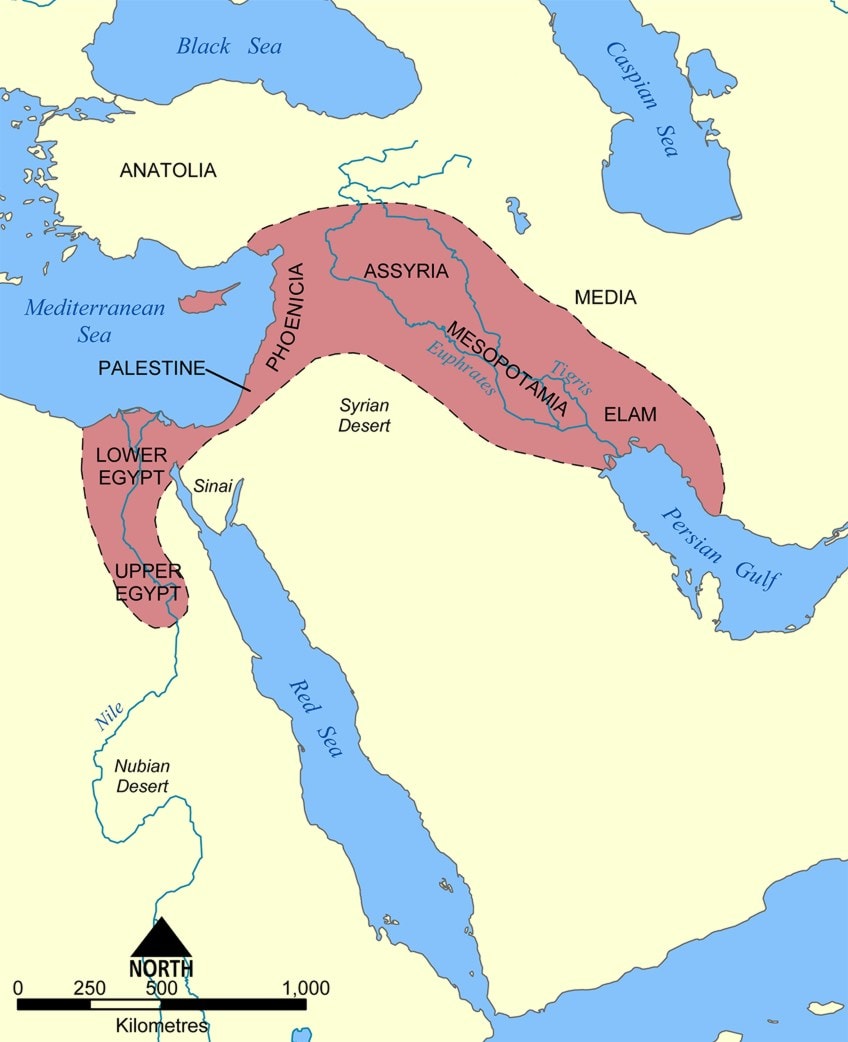 This map shows the location and extent of the Fertile Crescent, a region in the Middle East incorporating Ancient Egypt; the Levant; and Mesopotamia;User:NormanEinstein, CC BY-SA three.0, via Wikimedia Commons
Some historical scholars also advise that the Agricultural, otherwise Neolithic, Revolution originated in ancient Mesopotamia. The dates suggested information technology started effectually ten 000 BC. Some of the primeval farming settlements or villages discovered date to around 11 500 BC to vii 000 BC. The archaeological site Tell Abu Hureyra is i case of this.
The people from Abu Hureyra are believed to have been hunter-gatherers who progressed to farming. Grinding tools were also excavated from this area, which suggests the inhabitants had admission to grains, perchance the harvest of wild grains every bit it has been suggested.
It has also been discovered that early inhabitants domesticated animals like pigs and sheep also effectually the time of eleven 000 to 9 000 BC, and farmed plants such equally barley, flax, lentils, and wheat, dating to around 9 500 BC.
The Mesopotamian cultures were considered avant-garde in their developments – they created aqueducts, irrigation systems, astronomy, philosophy, the earliest forms of writing, and much more. It was one of the most circuitous regions in the world because of the diversity of cultures that moved through information technology.
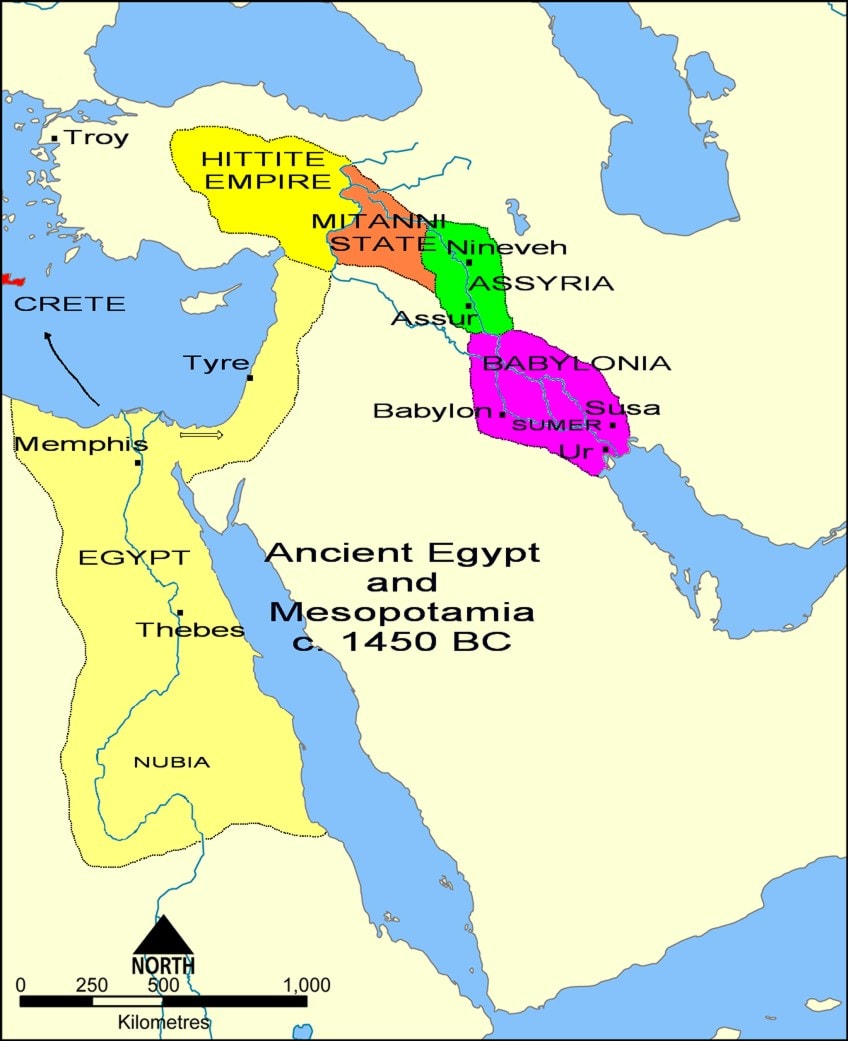 A map of Ancient Egypt and Mesopotamia, c. 1450 BC; Свифт/Svift, Public domain, via Wikimedia Commons
Some of the important civilizations from ancient Mesopotamia include Sumerians, Akkadians, Assyrians, and Babylonians. While there were many urban center-states throughout Mesopotamia, some of the important cities included the Sumerian Uruk, Ur, and Nippur. In that location was likewise Akkad, which was the capital city of the Akkadian Empire, the Assyrian cities Nineveh and Assur, and Babylon, the majuscule city of the Babylonian Empire.
Earliest Ancient Civilizations: Sumer
Sumer was one of the earliest Mesopotamian civilizations, which originated earlier the Akkadians, mentioned above. Sumer is in the southern role of Mesopotamia and is believed to have been settled around four 500 BC to 4 000 BC.
The proper noun "Sumer" was given to the Sumerians past the Akkadians, ironically.
"Black-headed people" or "Black-headed ones" is what the Sumerians used every bit their name for themselves. The Akkadians also used this terminology for the Sumerians. The word Kengir, meaning "Country of the Noble Lords" was the name the Sumerians used for their land.
At that place is a lot of scholarly debate about who the first people were to settle in Sumer; some advise West Asian and others Northward African. It is generally believed that the showtime populations or settlements in Sumer were the Ubaidians or "proto-Euphrateans".
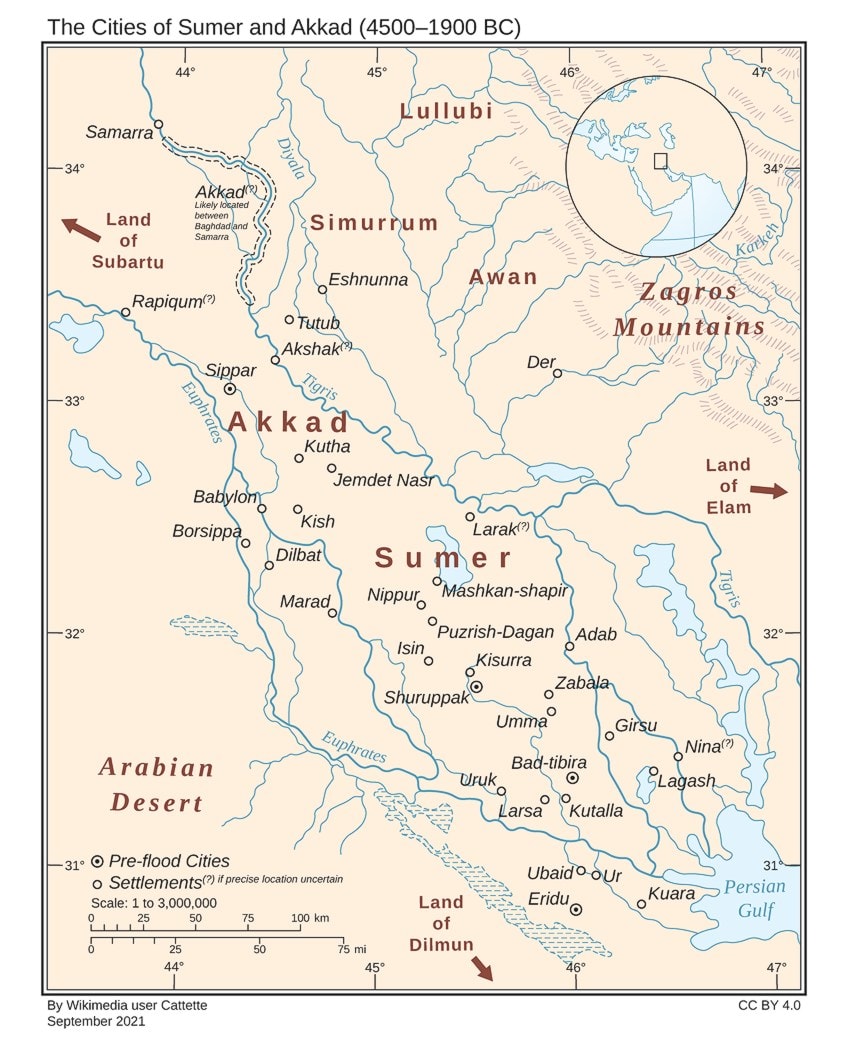 A general map of ancient Sumeria and Akkad featuring countries, rivers, historical coastline, and populated settlements; Cattette, CC Past 4.0, via Wikimedia Eatables
Co-ordinate to various sources, the Ubaidians started agriculture past draining the surrounding marshes, they as well developed trading systems and various crafts like weaving, metalwork, leatherwork, pottery, and masonry. The commencement and oldest settlement was believed to be Eridu, located southwest of the city chosen Ur.
Eridu was reportedly among 5 of the cities that were ruled by either a male monarch or a "priestly governor" before floods were destroyed. The settlements were congenital around respective temples that venerated a patron god or goddess.
The Sumerian god, Enki, was also believed to have originated from Eridu at a identify chosen Abzu, the waters or ocean, otherwise aquifers, under the world; he was the god of h2o. Enki'due south temple, otherwise referred to as the "House of the Aquifer", was in the eye of Eridu. The other pre-flood Sumerian cities include Bad-tibira, Larak, Sippar, and Shuruppak.
The Importance of Uruk
Uruk was considered one of the beginning "existent" city-states when Sumerian civilization became more urbanized. It started around 4 000 BC and lasted until around three 200 BC. There were various state formations similar societal stratifications, military, and administration systems. Information technology was divided into the Early Uruk Catamenia (c. iv 000 BC to iii 500 BC) and the Late Uruk Period (3 500 BC to 3 100 BC).
Information technology was one of the largest city-states in southern Mesopotamia with around xl,000 inhabitants and an estimation of around fourscore,000 to 90,000 people in the surrounding areas. It is believed to have reached its height effectually ii 800 BC.
The Sumerian King List reportedly indicates that Uruk had v dynasties. Information technology is worth noting that the 5th ruler (of the first dynasty) was the famous Gilgamesh who ruled effectually two 900 BC to ii 700 BC. He was as well the subject of the ballsy poem called the Epic of Gilgamesh (c. two 100 BC to 1 200 BC).
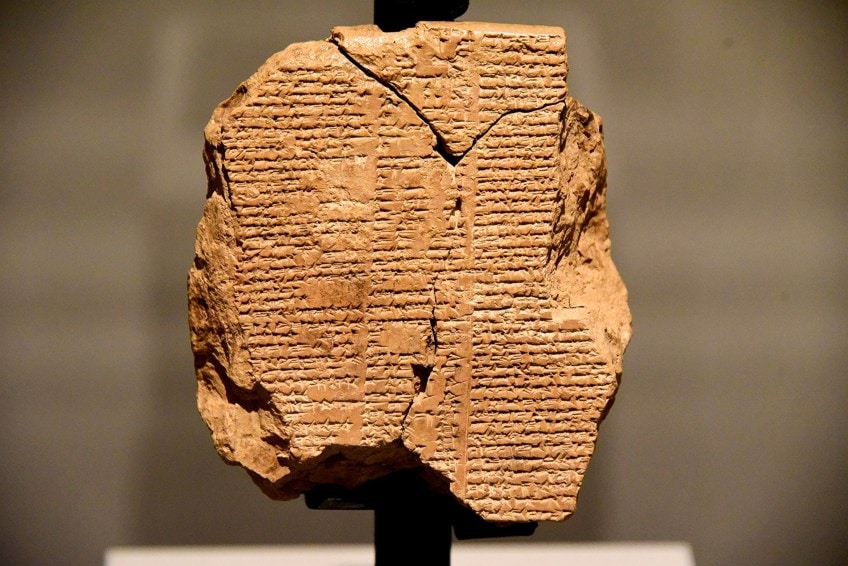 The newly discovered tablet V of the Ballsy of Gilgamesh: Meeting Humbaba with Enkidu at the Cedar Woods, Old-Babylonian Period, 2003-1595 BCE;Osama Shukir Muhammed Amin FRCP(Glasg), CC By-SA four.0, via Wikimedia Commons
Uruk is an of import Sumerian city to note because of its advancements in urbanization as we will see from the broad range of the Sumerians' architecture. Included were cultural advancements similar writing, which is now known every bit the cuneiform script. It was initially used to tape business organisation transactions. These transactions were for purposes of keeping records of food and cattle. It was used by the ruling priests of the area.
The cuneiform script was made past pressing down a cut border from a reed onto a clay tablet that was however soft. This created a shape that appeared like a wedge. The name also originates from the Latin meaning "wedge-shaped".
This written language became a very flexible 1 considering information technology could convey not merely words but besides numbers and concepts.
Sumerian Art
The Sumerian civilization was non only avant-garde in agriculture, economics, and many other facets of life, simply they were also artists and builders. Their artworks served unlike purposes and functions and the addition of decorative elements gave any object a new graphic symbol.
We volition run across this in the numerous Sumerian statues throughout the dissimilar dynasties. For example, the Standing Male Worshipper (c. two 900 BC to 2 600 BC), at present housed in the Metropolitan Museum of Art in New York, depicting a man continuing with both his hands cupped in front of his breastbone with a lustrous long beard and open up eyes gazing outward; his facial features have been sculpted in an animated mode.
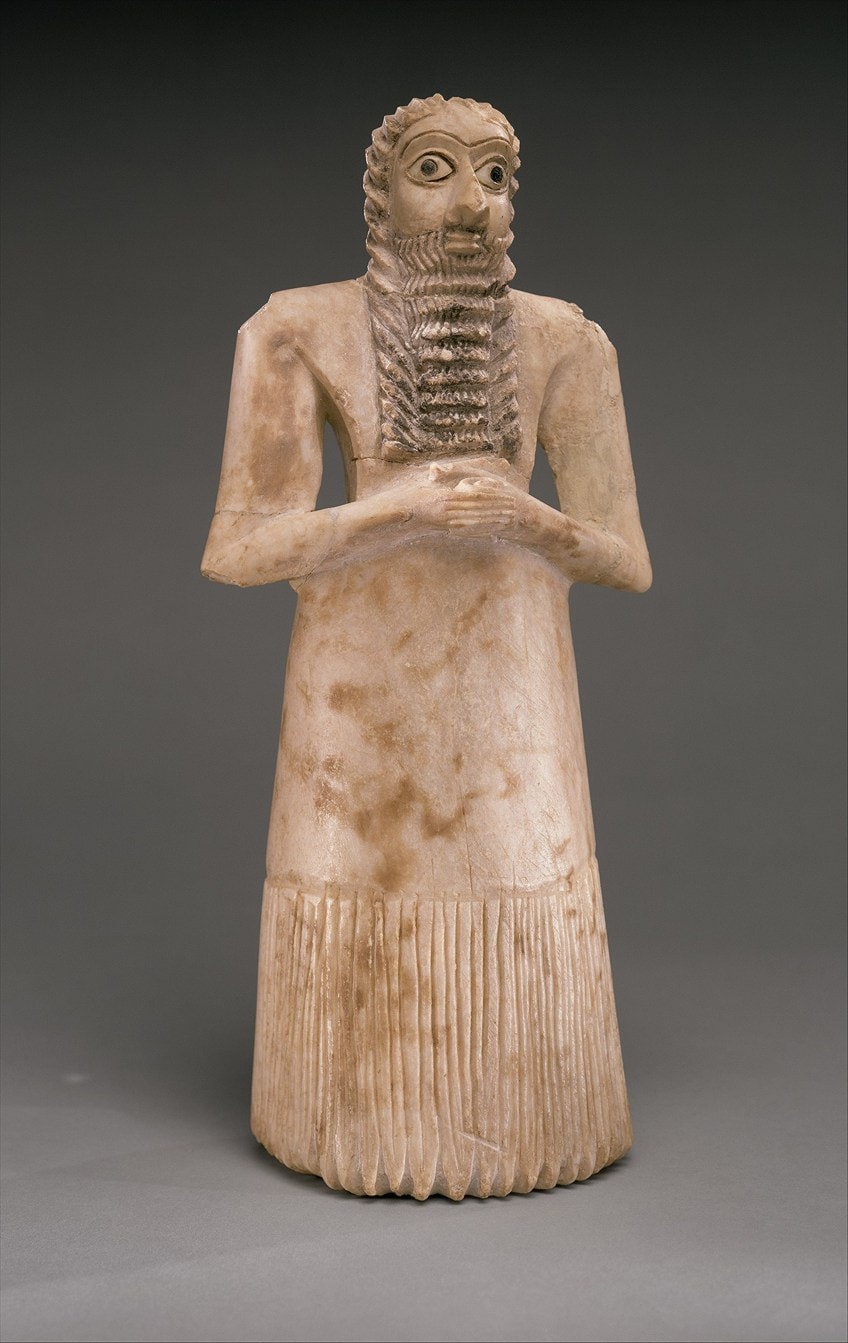 Continuing male worshipper, i of the twelve statues in the Tell Asmar Hoard; 2900-2600 BC; Metropolitan Museum of Art, CC0, via Wikimedia Commons
Not only were the Sumerians skilled at pottery and sculpture, but they produced beautiful pieces with these decorative elements made from semi-precious stones similar alabaster, lapis lazuli, and serpentine to proper name a few. Some of these stones were too imported. They used metals like silver, gilt, bronze, and copper as inlays and designs on diverse objects.
The Sumerians also used rock and clay. Clay was a pop medium to work with, possibly due to the clay present from the soil, and we will see a lot of Sumer art fabricated from it. Decorative elements would beautify various items similar jewelry, carved heads, musical instruments, ornamentation, weapons, cylinder seals, and many others.
The majority of Sumer art originates from gravesites; indeed, many objects, often important objects, were buried with the dead.
This also tells us that fine art served potent religious purposes during this catamenia. One of the most important archaeological discoveries in history has been that of Sir Leonard Woolley, his wife Katharine Woolley, and their collaboration with the British Museum and the Museum of University of Pennsylvania.
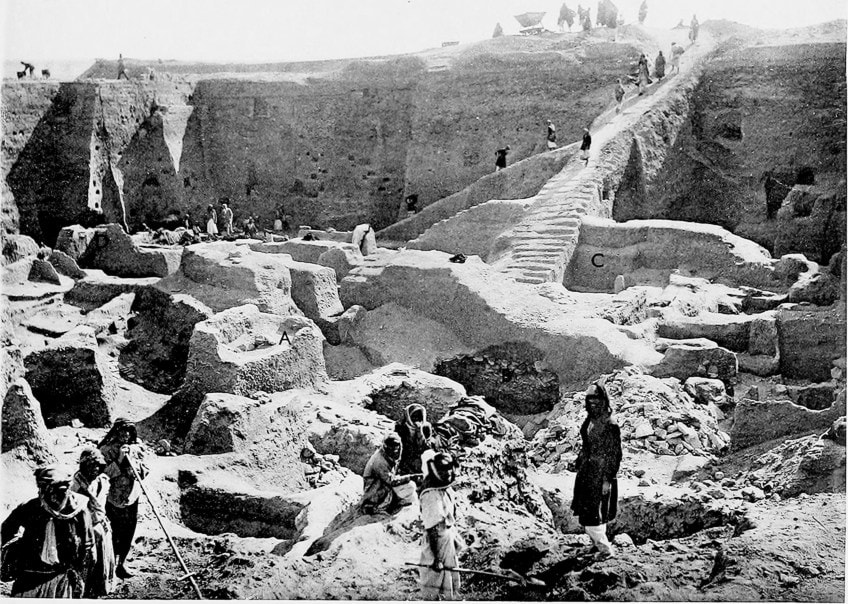 Royal Cemetery of Ur excavations;Joint Expedition of the British Museum and of the Museum of the University of Pennsylvania to Mesopotamia Hall, H. R. (Harry Reginald), 1873-1930, ed Woolley, Leonard, Sir, 1880-1960 Legrain, Leon, 1878- ed, No restrictions, via Wikimedia Commons
From 1922 to 1934, Woolley, who was a British archaeologist, led an excavation at one of the Sumerian cities called Ur. The layout of the city consisted of central mud-brick temples with a surrounding cemetery. This is besides where they discovered the Royal Cemetery, which was reportedly in an area used as a large rubbish heap where people could not build.
Instead, it was utilized as a burial site with various tombs that are believed to accept belonged to Sumerian royalties.
The cemetery was dated from around 2 600 BC to two 000 BC and the discovery of xvi graves dates these to effectually the middle of 3 000 BC. The tombs were also different in arrangement and size. The excavation team reportedly establish over 2000 burials.
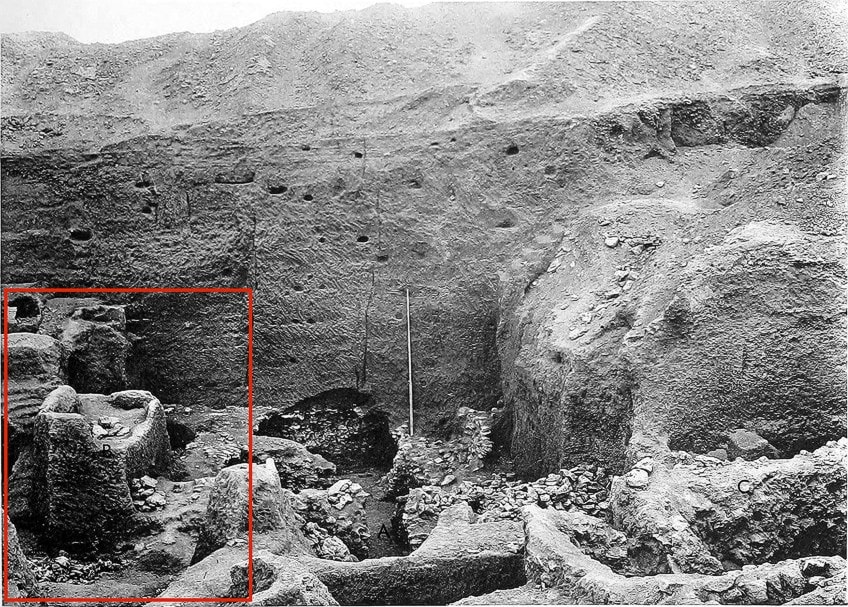 Grave of Meskalamdug (PG 755, B) at Ur, side by side to royal tomb PG 779 (A) and regal tomb PG 777 (C), 1934;Internet Archive Volume Images, No restrictions, via Wikimedia Commons
The tombs housed a plethora of objects like pottery including bowls, jars, and vases, jewelry, cylinder seals with inscriptions of the names of those who were dead, musical instruments of which lyres were quite prominent, sculptures, Sumer paintings, and many others.
1 of the famous burying sites belonged to a adult female, believed to be a "queen", called Puabi.
She lived in the First Dynasty of Ur, around 2 600 BC. She was referred to as nin from the discovered cylinder seals. Nin is a Sumerian word that was used to refer to someone who was designated every bit a queen or priestess. Information technology has also been translated to hateful "lady".
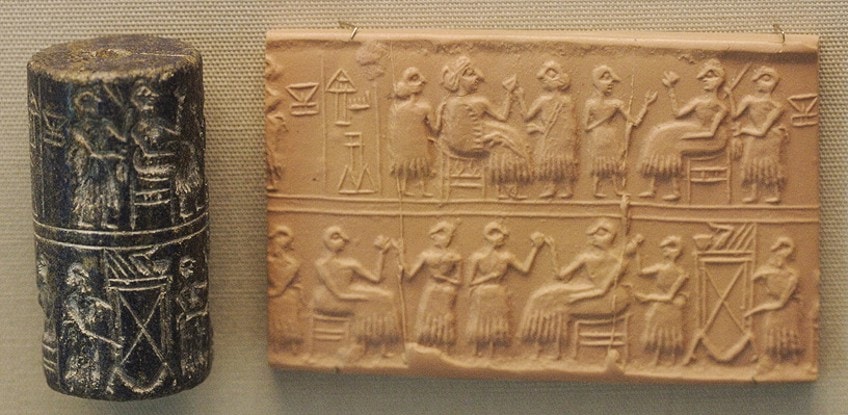 Cylinder-seal of the "Lady" or "Queen" (Sumerian Nin) Puabi, one of the main defuncts of the Royal Cemetery of Ur, c. 2600 BC. Banquet scene, typical of the Early Dynastic Flow;Nic McPhee from Morris, Minnesota, United states of america, CC BY-SA 2.0, via Wikimedia Commons
Her burial grave included numerous items that were tied to wealth, these were also high in quality items like jewelry, headdresses, including her own headdress with gilded floral motifs and chaplet fabricated from lapis lazuli and carnelian.
Sources also state these gravesites were looted over the years except for Puabi's grave, which undoubtedly elicited questions nigh her status and importance in the Sumerian gild.
It is of import to think there are hundreds of discovered Sumerian artifacts, all from different regions and all with dissimilar purposes and stories. Below we will hash out only a few of the famous pieces of Sumerian art, including, but not limited to some of the items discovered from the Imperial Graves, including that of Puabi's grave. Information technology is encouraged to undertake more extensive enquiry to detect all the other unique and beautiful Sumerian art pieces that adorn our museums in the present twenty-four hours.
Ram in a Thicket (c. 2 600 BC to 2 400 BC)
The Ram in a Thicket (c. 2 600 BC to 2 400 BC) is a figurine of a ram, really a goat, standing on its hind legs in front of what looks like a tree, possibly reaching for some food. This figurine came in a pair; the two were excavated from what was called the "Great Death Pit" in the Majestic Cemetery at Ur, lying not too far apart from each other.
The British excavator, Leonard Woolley chose the name, Ram in a Thicket, because it resembled a reference from the book of Genesis, 22:13, in the Bible when Abraham was about to sacrifice Isaac, his son:
"Then Abraham looked up and saw a ram caught by its horns in a thicket. Then he took the ram and sacrificed it as a burnt offering in place of his son".
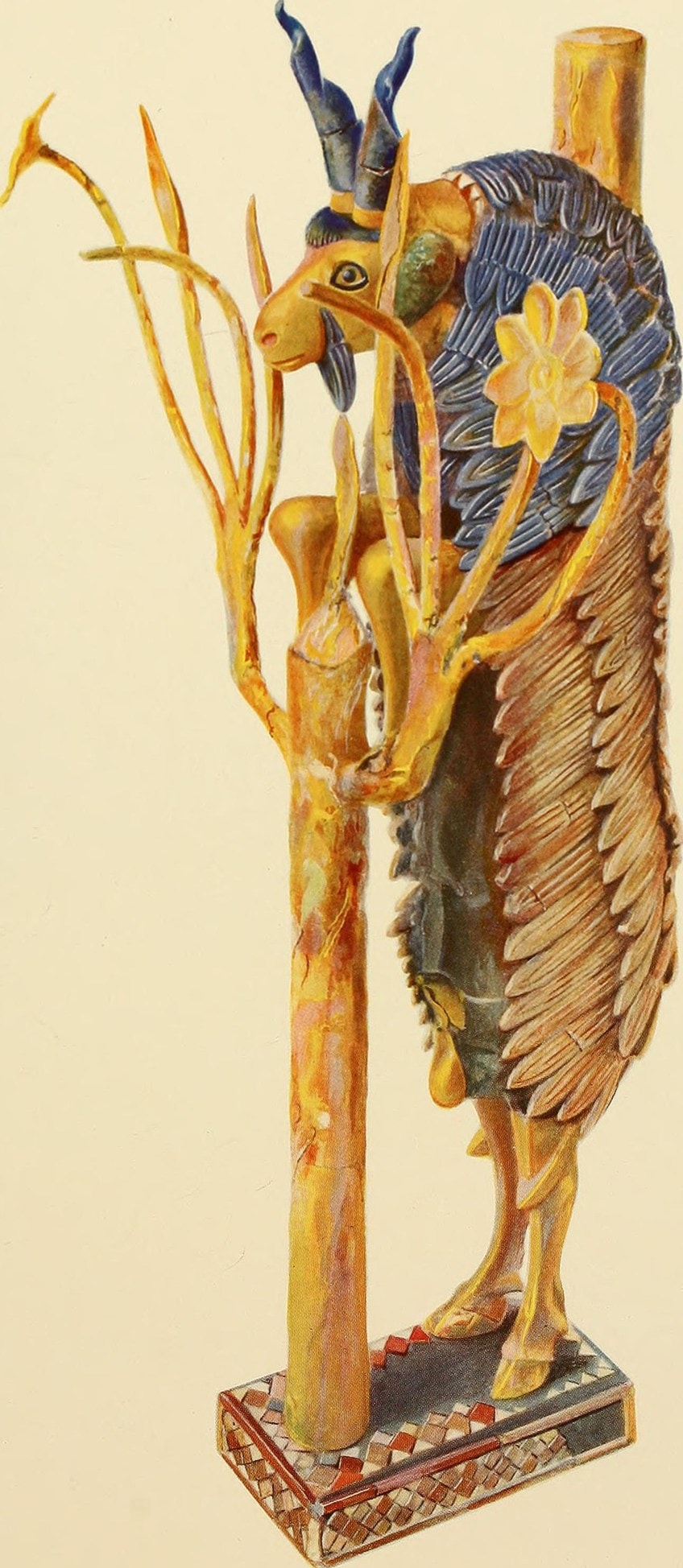 Ram Caught in a Thicket, c. ii 600 BC to two 400 BC., one of the two goat statuettes from the "Great Death Pit" of the Ur excavations; Yard. Louise Bakery, No restrictions, via Wikimedia Commons
The effigy measures 45.7 x thirty.48 centimeters and is equanimous of silvery, gold, lapis lazuli, shell, copper alloy, red limestone, and bitumen. An interesting fact about bitumen (or asphalt) is that the Sumerians used it as an adhesive. The Sumerian word for bitumen is believed to be esir.
If we look more than closely at the Ram in a Thicket, we volition notice it has a wooden cadre. The head and legs are covered in gold leaf that is attached to the wood; the adhesive qualities of bitumen keep information technology pasted on. The ears are made from copper. The horns are made from lapis lazuli.
From the dorsal view of the ram, at that place is what appears to be a fleece covering its upper shoulder area, which is also made from lapis lazuli; the fleece that covers the remainder of its torso is fabricated from vanquish, also stuck on using bitumen. The ventral view shows the ram's stomach area is fabricated from a silver plate, merely this is reportedly oxidized and unrepairable. The ram's genitals are made from gold.
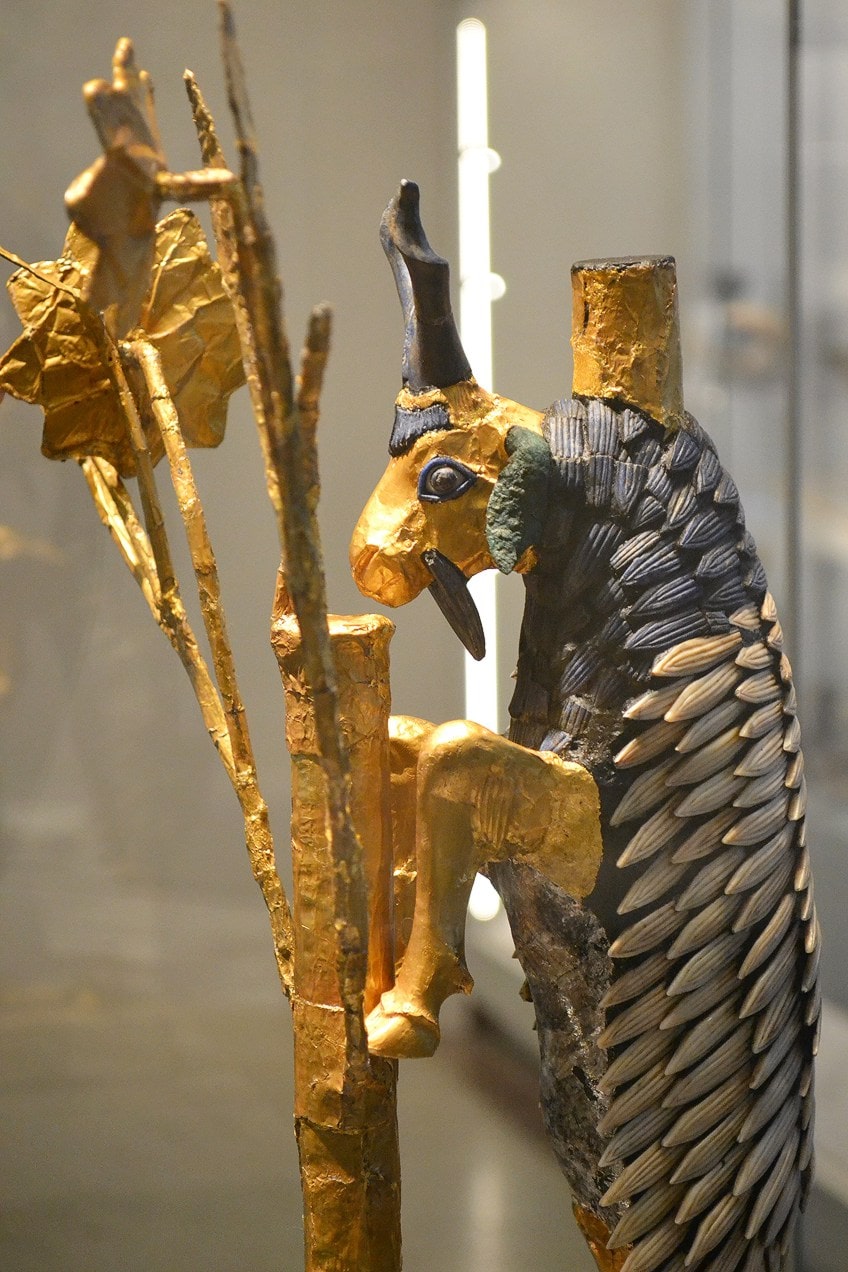 One of two statuettes excavated from Ur's "Great Death Pit" and dubbed the "Ram in the Thicket" past Sir Leonard Woolley;Torquatus, CC Past-SA four.0, via Wikimedia Commons
The tree itself is golden in color, made from gilt foliage with aureate flowers at the end of each branch. Both the ram and tree are on a small rectangular platform made from shell, lapis lazuli, and cerise limestone. It appears like a mosaic pattern roofing the base. At that place is also a small tube protruding from each ram'southward upper shoulder area, believed to take possibly been for supporting an object like a bowl.
Currently, the rams are in two unlike museums, one is in the British Museum's Mesopotamia Gallery in London. The other ram is in the University of Pennsylvania Museum of Archæology and Anthropology.
Standard of Ur (c. 2 600 BC to 2 400 BC)
The Standard of Ur (c. ii 600 BC to two 400 BC) was excavated from the Royal Cemetery at Ur, also during the excavations led past Leonard Woolley. Information technology was found virtually the shoulder of a man in the corner of a tomb believed to accept been dedicated to Ur-Pabilsag, a male monarch during the First Dynasty of Ur during the 26th century BC.
Woolley suggested the detail was used as a standard, which is related to someone carrying an paradigm that relates to a person of loftier status similar a male monarch in this regard.
Notwithstanding, in that location has been debate every bit to the existent function of this particular, some as well suggested it was used as a storage box or a sound box. The item was considerably damaged over the centuries from the weight of the soil and the disuse of the wood. There take been restoration attempts fabricated to arrive appear how it could have looked when it was used.
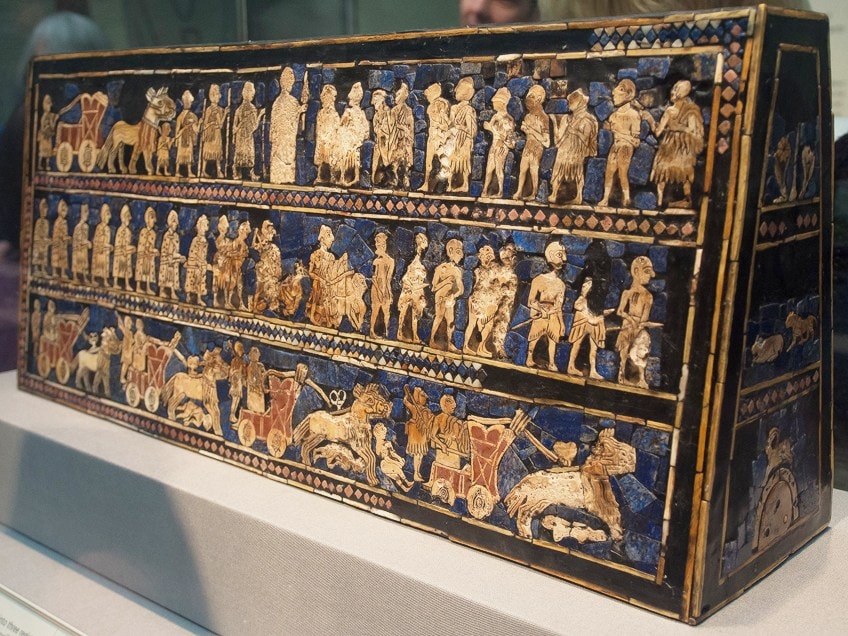 The Standard of Ur, 2600 BC (the Early Dynastic Period III), discovered at the Regal Cemetery at Ur (Dhi Qar Governorate, Iraq); Denis Bourez from France, CC Past ii.0, via Wikimedia Commons
Every bit nosotros see it at present, it is a hollow wooden box measuring 21.59 centimeters in width and 49.53 centimeters in length. There are inlays along each length and end of the box. These are made from red limestone, lapis lazuli, and shell, in a mosaic format. The box's length is divided into three panels.
What is then unique about this box is that the mosaic inlays are depicted in particular telling a visual story. The narrative and subject affair have been titled "War" and "Peace" because in that location are figures that relate to the military and other figures that announced to be involved in a banquet.
If we look closer, the "War" panel depicts various figures from the Sumerian ground forces. In the elevation panel, from the left, we come across a man standing by a wagon pulled by four donkeys. At that place are members of the infantry with cloaks and spears and a fundamental, taller, effigy, mayhap the king, property a spear awaiting a procession of oncoming prisoners from the right. Each prisoner seems to exist naked and possibly escorted past members of the infantry.
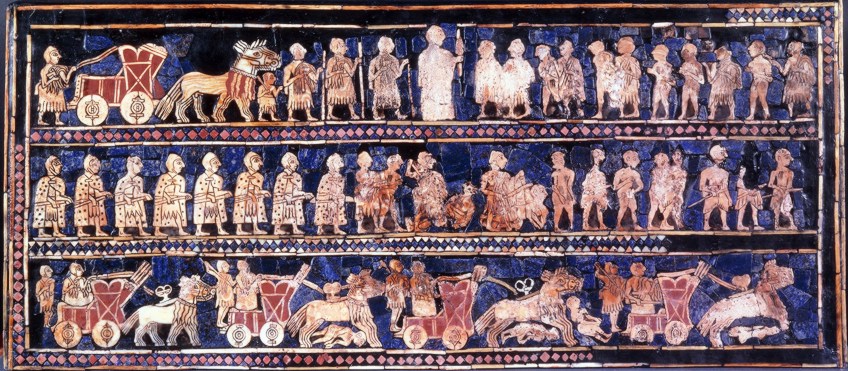 Standard of Ur, 2600 BC, "War" panels; Unknown writer Unknown author, Public domain, via Wikimedia Commons
The middle panel depicts what appears to be more members of the ground forces and perpetrators existence struck and killed. From the left, there are eight men wearing the aforementioned military machine garments (cloaks and helmets) with weapons. Information technology appears equally if they are approaching an ongoing battle that nosotros see depicted on the right side of the panel. The lower panel of the box depicts four wagons led by four donkeys for each. In each wagon, there is a driver and a soldier ready to fight. We will as well observe under three of the wagons are expressionless bodies of the enemies killed from the wagon's weight and those on it.
The wheels depicted on the wagons are solid structures, a telling portrayal of what it could have looked like in real life.
There is also a dynamism portrayed in the ass'due south stances; from the left, the first wagon with donkeys is seemingly walking, the wagon and donkeys in forepart of them seem to exist going at a bit of a faster pace, otherwise referred to as a canter. The third set of wagons and donkeys appear to be galloping and the last set of donkeys are rearing.
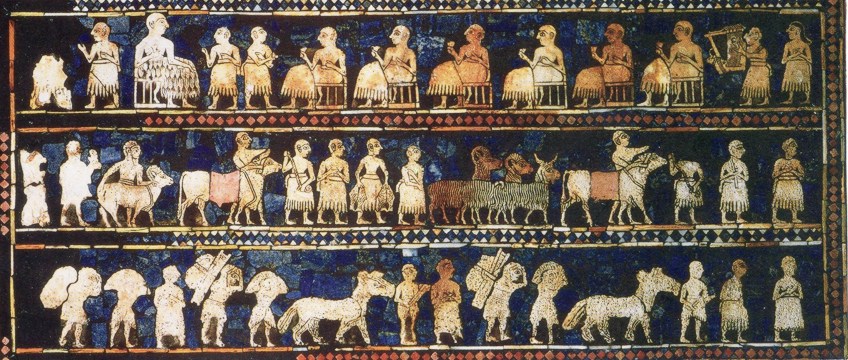 Standard of Ur, 2600 BC, "Peace" panels;Alma E. Guinness, CC0, via Wikimedia Eatables
If we await at the "Peace" panels, starting from the top panel, nosotros will come across the king on a stool to the left. There are six figures, as well seated, holding cups in their correct hands, all facing the king, who too holds a cup in his correct hand. There are various attendants and a musician holding a lyre, standing as the 2nd figure from the right side. In the middle portion of the "Peace" panel, we volition notice various figures ushering in animals that appear to exist rams and cows. Some figures likewise announced to hold fish.
The lower portion of the console depicts figures with donkeys and packs on the backs, possibly of foodstuffs. These processions of figures from the middle and lower portion of the panel could be on their way to the banquet with offerings towards the feast.
The Queen's Lyre (c. 2 600 BC)
The Queen'southward Lyre (c. 2 600 BC) was found amid numerous other lyres from the Purple Cemetery at Ur. With a height of 112.fifty centimeters and a length of 73 centimeters, this Lyre was found at Queen Puabi's gravesite. The wood that equanimous it was damaged from all the years in the gravesite, only it has been restored in various parts. Leonard Woolley reportedly institute two lyres in the queen's grave.
When we look at information technology more than closely, we run across the music box is in the shape of a bull. The head and face are gold with lapis lazuli composing the caput's pilus, the "beard" of hair under the bull'southward face, and its eyes, which are also made from shell. The two white horns are obviously not part of the original, ancient, figure, but mod additions that give u.s. an indication of what it looked like.
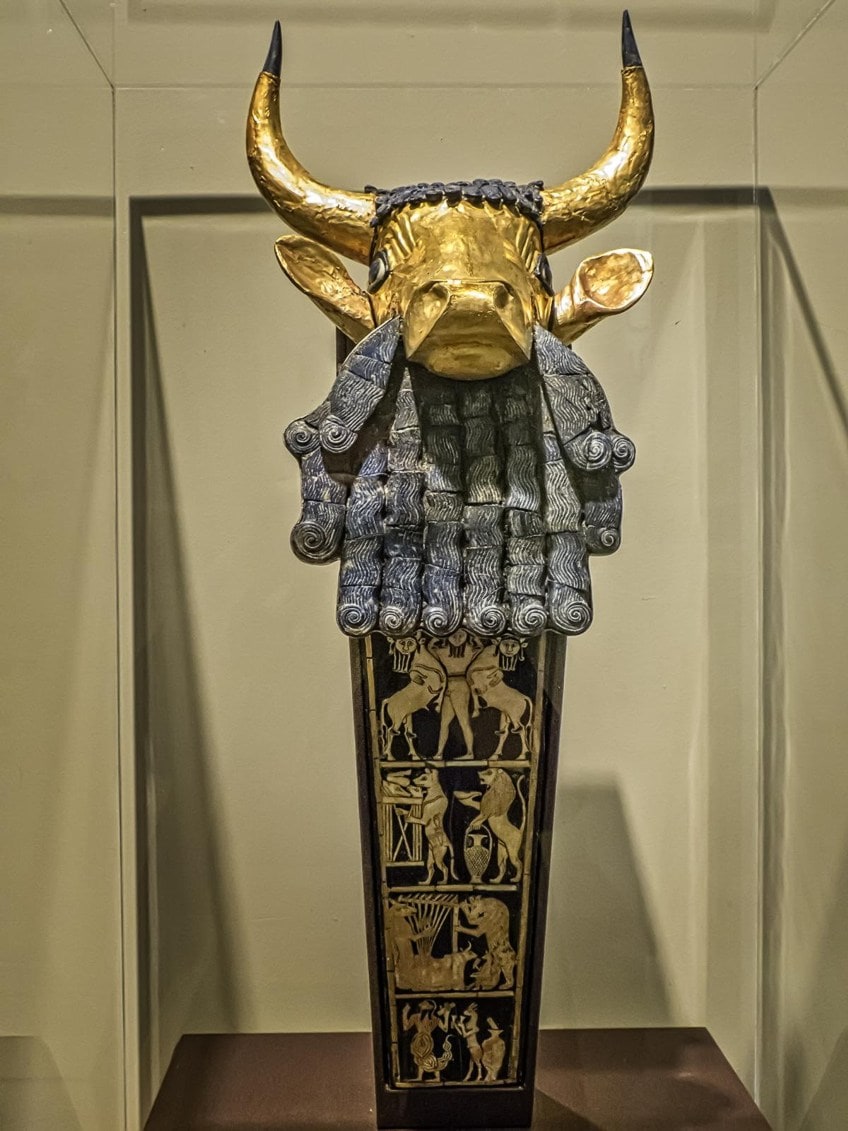 The Queen'southward Lyre from grave PG 800 at the Purple Cemetery of Ur, southern Mesopotamia, Iraq. Early dynastic flow, circa 2500 BCE; Osama Shukir Muhammed Amin FRCP(Glasg), CC BY-SA 4.0, via Wikimedia Commons
Equally we move further down, what would theoretically exist towards the ventral view of the bull's body, but is actually the curving of the music box, we run into the similar mosaic panels made from the same material as the above Standard of Ur, shell, red limestone, and lapis lazuli.
This forepart panel is divided into four squares, each depicting images.
The superlative prototype is an eagle with a lion'south head and spread wings with two flanking gazelles. The next prototype is described past diverse sources as "bulls with plants on hills". However, when we look closely these announced like ii rams standing on their hind legs reaching up a tree on some sort of basal mound. These are reminiscent of the Ram in a Thicket figurines.
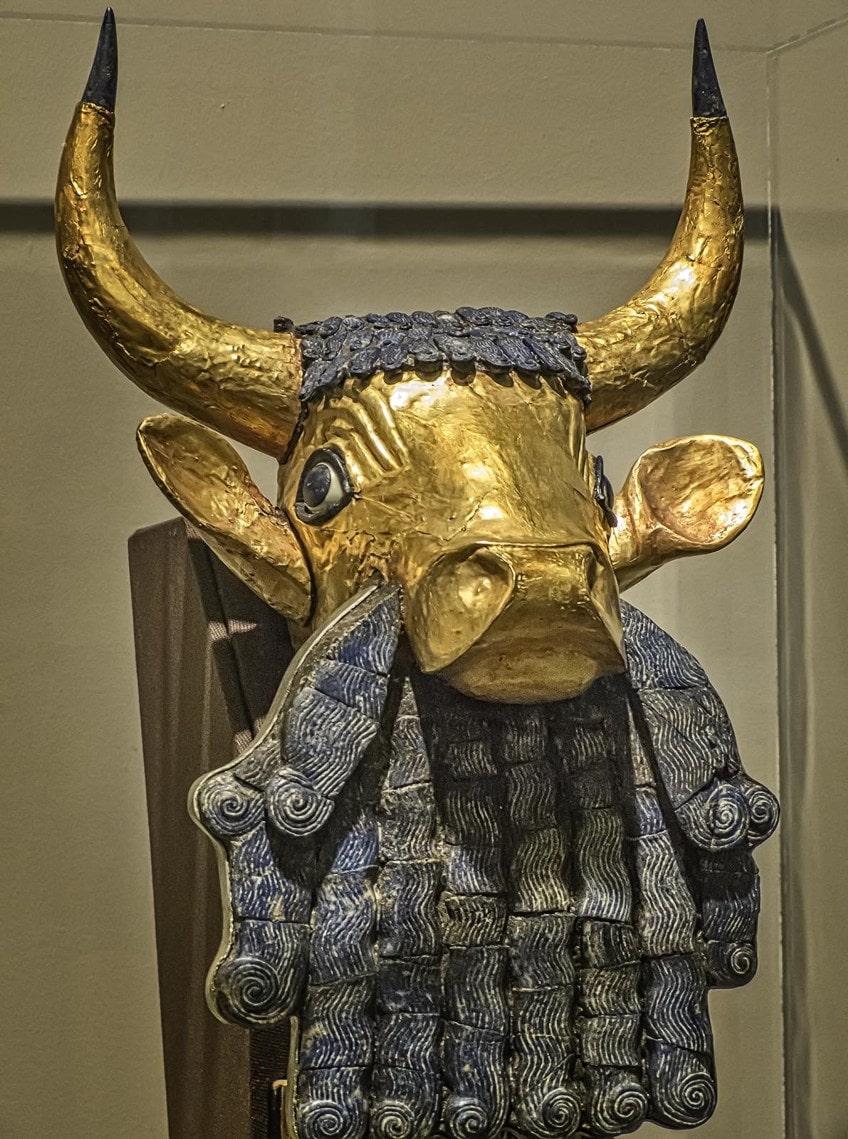 The Queen's Lyre from grave PG 800 at the Royal Cemetery of Ur, southern Mesopotamia, Iraq. Early dynastic period, circa 2500 BCE; Osama Shukir Muhammed Amin FRCP(Glasg), CC By-SA 4.0, via Wikimedia Eatables
The third foursquare, so to say, depicts a figure with the torso of a ram or bull and the torso of a man, holding up two Leopards (or Cheetahs?) by their hind legs. The last square depicts a lion decorated sinking its teeth into a bull. There is also a tree shape in the background, similar in advent to the ii trees from the second foursquare.
Warka (Uruk) Vase (c. 3 200 BC – 3 000 BC)
Warka is the modern name for the aboriginal Sumerian city that was called Uruk. The alabaster Warka Vase (c. 3 200 BC to 3 000 BC) is some other instance of the beauty of Sumerian carvings. The measurements take been debated for this vessel, as a field book entry from 1934 (when it was found) stated information technology was around 96 centimeters high, whereas other sources state it is 105 and 106 centimeters high.
Regardless of its measurements, it is safety to say information technology is effectually 1 meter alpine. Its bore is measured equally existence 36 centimeters.
The Warka Vase was found by a group of German excavators around the years 1933 to 1934. It was in the temple dedicated to the Sumerian goddess chosen Inanna. She presided over beauty, sexual practice, love, justice, and state of war. The Sumerian carvings are washed as relief carvings and span around the vessel divided into 4 panels, otherwise known as registers.
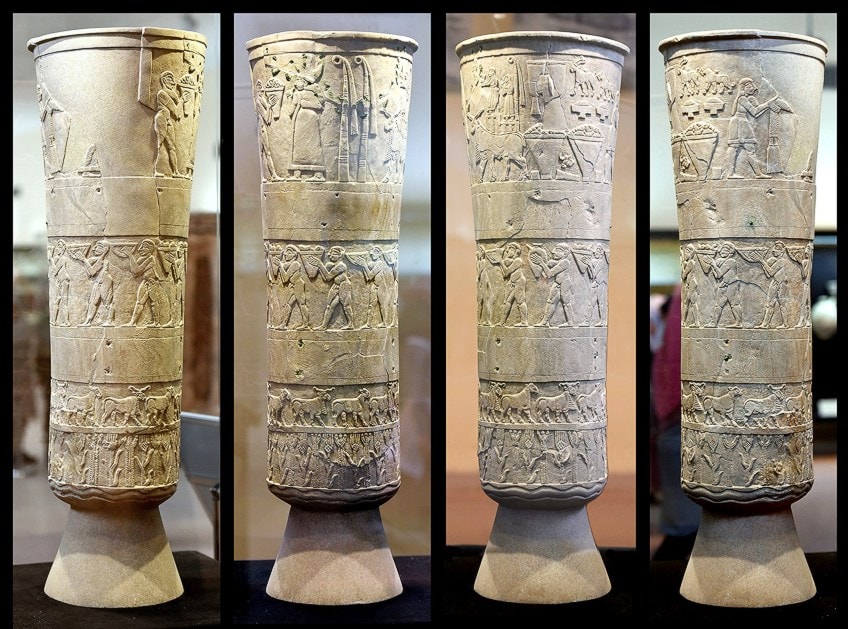 Warka Vase from all angles;Osama Shukir Muhammed Amin FRCP(Glasg), CC By-SA 4.0, via Wikimedia Commons
Each register depicts dissimilar figures and objects from nature; the bottom console is filled with water at the bottom and growing crops of what appears to be barley and wheat amidst reeds; the second panel depicts rams and ewes. In the third panel, we see 9 nude figures of men carrying containers or baskets with nutrient in it. The top console depicts more characters, including the goddess Inanna and the rex.
There are differing ideas as to what narrative the subject affair portrays; some suggest it is a marriage between the king and queen and others that it is a celebration of the queen. This vessel is housed in the National Museum of Iraq.
Sumerian Architecture
The Sumerians' compages is another important part of not only Sumer culture, but Sumer art. Almost buildings were made of clay bricks, a widely spread cloth. Sumerians were also known equally ane of the offset cultures to undertake urban or urban center planning. Buildings ranged from houses to palaces and there were unlike functions, for example, commercial, civic, and residential.
As described from a few examples higher up, we will typically find a temple as a central edifice.
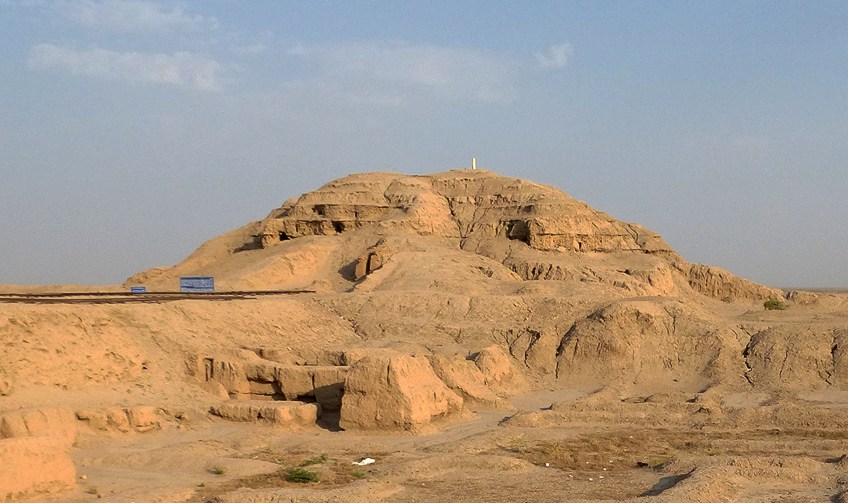 White Temple ziggurat in Uruk; tobeytravels, CC Past-SA 2.0, via Wikimedia Commons
The Ziggurat was an important structure, in the shape of a pyramidal tower, or "raised platform". It was built to venerate the dedicated god or goddess, and a reminder of the political leaders who acted on behalf of that deity, this was a large part of the Sumerian theocratic organisation.
An example of the above was the White Temple (c. 3517 BC to 3358 BC) built on the Anu Ziggurat in Uruk. Anu was the god of the sky. Nevertheless, nearly over 30 such temples are recorded to exist in various locations around Mesopotamia.
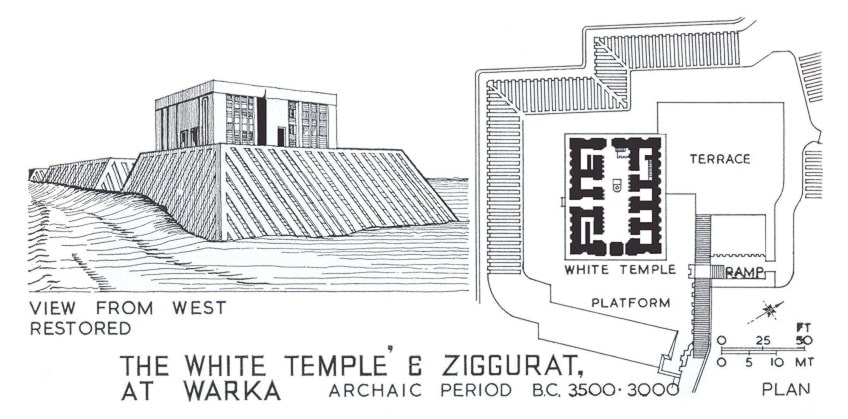 Plans of White Temple and Ziggurat at Uruk, 3500-3000 BCE;Fletcher Banister, published in 1898, Public domain, via Wikimedia Commons
From Writing to Wheels: The Sumerians Remembered
The Sumerian civilization was succeeded by the Akkadians, led by the ruler Sargon of Akkad, from 2334 BC to 2154 BC. After the Akkadian Empire savage there was a flow referred to as a "Dark Historic period" after which there was a resurgence in Sumerian culture with the beginning of the Third Dynasty of Ur (2112 BC to 2004 BC). This was also called the Neo-Sumerian period. It has been compared to a sort of "Gilt Age" of the Sumerian Civilization and revival of arts, especially religious arts.
The Sumerians were undoubtedly advanced in many ways, setting the stage for many civilizations to come in and then many disciplines in life similar art, scientific discipline, religion, politics, agronomics, and more. They have been lauded equally some of the greatest ancient inventors, recall of the cycle and writing. And now in our modern-mean solar day, we nevertheless recall them as a civilization rich in culture, adorned with gems of wisdom just like the fine art they created.
Have a look at our Sumerian fine art period webstory here!
Oft Asked Questions
When Was the Sumerian Period?
Sumer was one of the primeval Mesopotamian civilizations originating before the Akkadian Civilization. Sumer is in the southern part of Mesopotamia and is believed to have been settled around 4 500 BC to iv 000 BC.
What Does "Sumer" Mean?
The name Sumer was given to the Sumerians by the Akkadians. "Black-headed people" or "Black-headed ones" is what the Sumerians used as their name for themselves. The word Kengir, meaning "Country of the Noble Lords" was the name the Sumerians used for their land.
What Kind of Art Was Created in Sumer?
The Sumerians created fine art from different materials like semi-precious stones, shells, forest, red limestone, metals like golden, argent, and copper, to name a few. These were all used in Sumer paintings and mosaics. Sumerian statues, sculptures, figurines, pottery, and various other objects were also discovered in large quantities by diverse archaeological excavations. The Sumerians' compages and tablets to write on in the cuneiform script were generally built using clay as this was a widespread and naturally occurring medium.
What Was the Purpose of Sumerian Fine art?
Sumerian art was beautifully busy with ornamentations and served religious and sacred purposes. Many of the Sumer fine art objects were discovered from gravesites and were buried with their respective owners. Temples were of import structures and were given great intendance in construction for the purposes of venerating respective deities.
0 Response to "What Is the Country Sumers Most Famous Work of Art"
Post a Comment